
Looking to go solar with no upfront cost?
Our Monthly TPO (Third-Party Ownership) programs—Power Purchase Agreements (PPA) and solar leases—make it easy to enjoy clean energy and lower utility bills without the hassle of ownership. Home Pro Roofing and Solar offers flexible monthly options designed for homeowners who want the benefits of solar power without the large investment.
What is TPO or Third Party Ownership?
When homeowners go solar, they can do so under two broad categories. They can buy their system themselves, either paying upfront out-of-pocket or financing with a loan, or they can utilize TPO or “Third Party Ownership.”
When someone buys their solar system, they own the equipment on their roof. When a homeowner goes with a TPO product, they do not own the system on their roof, either the installing solar company or a financial company does. There are two types of TPO: Power Purchase Agreement and Lease.
What is a Power Purchase Agreement?
A Power Purchase Agreement, or PPA, is when the solar company or a third party developer owns, operates, and maintains the solar system on the homeowner's roof. The customer enters into an agreement, usually 20 or 25 years, and agrees to purchase the electricity from that solar system instead of continuing to purchase electricity from the power company.
In a way, customers have had a "power purchase agreement" with their utility company since they've had an electric bill, but there are some significant differences. With the power company, they have zero say or control over what they're paying per kWh and often experience random price hikes. With our solar PPA, they'll know exactly what their electricity will cost for the duration of their agreement.
Another difference is what exactly the customer is paying for. Right now, with the power company, they are paying a certain amount for each kWh they consume. With a PPA, they will pay a certain amount for each kWh their system produces.
What is a Lease?
A lease is similar to a PPA, but it has some notable differences. A solar company or a third party developer owns, operates, and maintains the solar system on the homeowner's roof, same as a PPA, and they are still entering into a long-term agreement, usually 20 or 25 years. The difference lies in what the homeowner is actually paying for.
A PPA customer pays for the electricity produced by their system, but a lease customer pays for the equipment. They still do not own the system on their roof, but because they're leasing the equipment, they pay no additional cost for any electricity produced. The vast majority of the time, PPAs and Leases are priced-out the same.
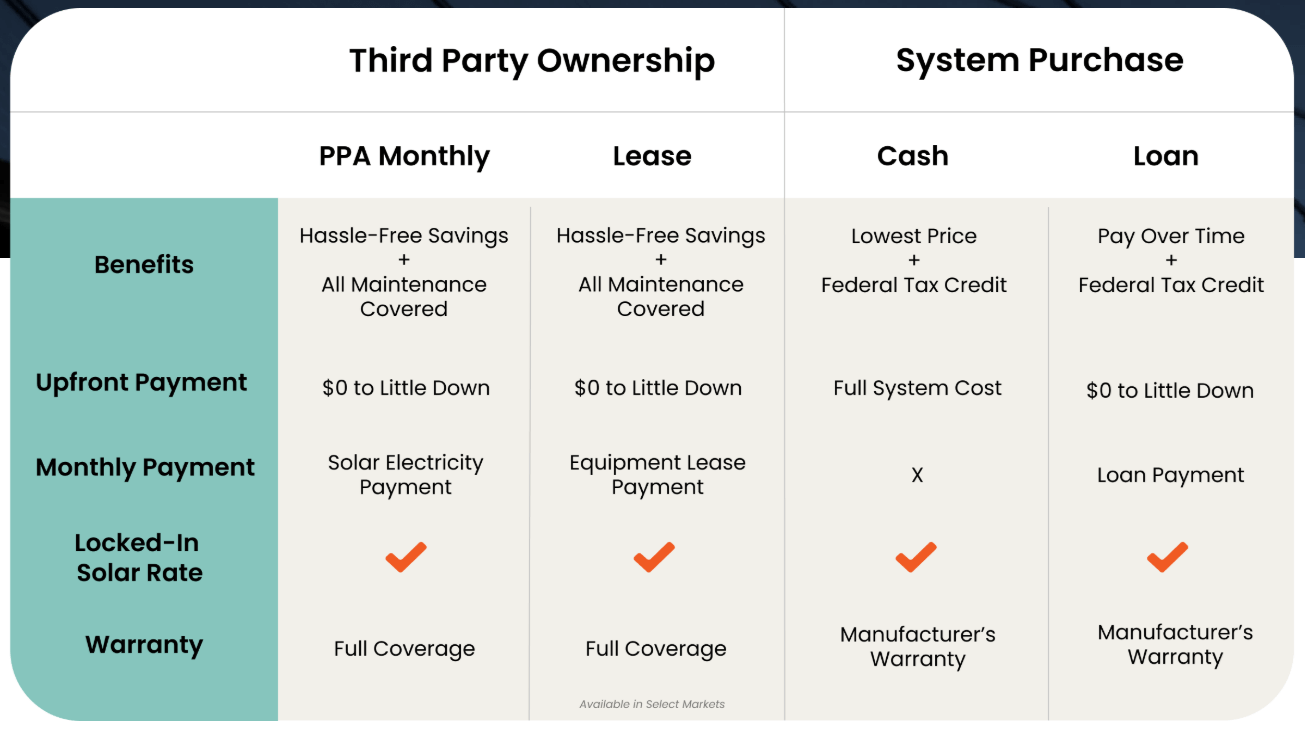
Why choose TPO?
As you know, there is no wrong way to go solar, only good options and the best option. There are benefits to owning your solar system, both emotional and logical, but sometimes it makes more sense for the customer to choose TPO. So, what are those times?
Tax Incentives
We all know about the 30% federal ITC which makes the switch to solar far more attractive and affordable. There are many customers who want to go solar, but for whatever reason, are not able to take advantage of the federal tax credit. Whether they're retired and on social security, on disability, or they're self-employed, if they don't pay enough in federal income tax to recoup their 30% tax credit, TPO is generally a great option.
When a homeowner signs up for TPO, they do not purchase the solar system; the solar company does. The tax credit goes to the purchaser of the solar system, which means the solar company gets the tax credit and passes those savings on to the customer. So, regardless of their tax liability, a homeowner can benefit from the federal incentive.
Long-Term Protection
When a homeowner purchases their solar system, whether it's with cash or a loan, they enjoy many warranties. These warranties vary based on the company the customer purchases their system from, but typically include workmanship and roof penetration warranties. Customers also have manufacturers' warranties on the equipment they purchased, the value of which completely depend on the financial strength of the manufacturer. If that company goes out of business, the homeowner's warranties are often rendered worthless.
PPAs and Leases normally come with increased protections because the solar company owns the system and are responsible for its maintenance, repair, etc. The exact coverage varies based on the company's agreement, but typically, if anything happens that is not the homeowner's fault or force majeure, it is the solar company's responsibility to repair it ASAP.
Of course, a customer still has protections when purchasing their system outright. They have all of the warranties that come with their system, both manufacturer and otherwise, but TPO typically offers more peace of mind and stronger guarantees - Especially with Axia by Qcells.
Insurance
When a homeowner purchases their solar system, they report it to their homeowner's insurance because the system becomes part of the home. This has varying effects on homeowners' premiums as sometimes rates are raised, lowered, or stay the same depending on their insurance company.
Customers who opt for TPO do not have to worry about insurance because the solar company who owns the system insures it. The customer does not own the system on their roof, so they do not need to report it to their homeowner's insurance.
Summary
A homeowner who signs up for TPO has a solar system, owned by a solar company, installed on their roof. They then pay for either the power produced (PPA) or the equipment (lease) in the form of ongoing monthly payments for the length of the term. These monthly payments typically come with a yearly escalator to compensate for inflation.
TPO products are ideal for people who would not qualify for the federal tax credit and would otherwise not benefit from the massive incentive. The solar company that purchases, owns, maintains, and insures the system recoups the tax credit and passes those savings on to the customer in the form of a reduced price and long-term protection.
Enfin Monthly TPO Product
Our industry-leading product is ideal for customers who would otherwise be unable to use the ITC or customers who’s debt-to-income ratio do not allow for a large loan. However, this TPO product could be an ideal alternative for a great many customers, even those who could fully benefit from financing their system with a loan.
Increased Protections
When a customer purchases a system, they get the following warranties:
- 25-year Workmanship
- 25-year Performance (*30 years if financed by Enfin)
- 25-year Solar Panel Product
- 12-year Battery Storage
- 10-year Inverter
- 10-year Roof Penetration
While that all certainly constitutes comprehensive coverage for purchase customers with Axia by Qcells, the coverage an Enfin TPO customer will enjoy is even better. As long as the system is not damaged by the homeowner (intentionally or by gross negligence) or force majeure (an "act of God" such as a hurricane or tornado, in which case homeowner’s insurance helps), they are completely covered for the entire 25-year term. Enfin owns the system and is responsible for any malfunctions, and must ensure the system produces the electricity we promised.
Customers will also enjoy a production guarantee, which guarantees that the system will generate at least 90% of the estimated output during the initial 25-year term. This will be calculated and paid out each year, starting after year two. If the system produces more than 100% of the estimated output during a calendar year, it will offset future underproduction.
Each customer will have a chart specific to them in their agreement that shows how much electricity is guaranteed, and at what rate per kWh they will be refunded in case of underproduction. The rates vary based on the customer's utility company and the rates they charge at the time the customer signed up.
Example: A customer signs up for TPO and their system is estimated to produce 10,000 kWh in a given year. That means it is guaranteed to produce 9,000 kWh. Due to extreme circumstances, the system produces only 8,000 kWh in that year. Based on the chart in the customer's PPA or Lease agreement, they will be paid $0.35 per kWh for underproduction, so they will be reimbursed $350.
Free Battery and Inverter Replacement
Yes, you read that correctly. Our batteries and inverters are currently warranted for 10 years. Their lifespan will vary based on how they're used, but it is likely a customer will need to replace their battery or inverter(s) down the road. If a customer purchases their system, they will need to come out-of-pocket once it becomes necessary after the expiration of their 10-year warranty.
If a customer signs up for our TPO, we're entering into a 25-year agreement with them. Since batteries and inverters are part of that agreement, when they need to be replaced, Enfin will replace them at no cost to the homeowner.
"When, if ever, can I buy-out the system?"
Customers can buy-out their system when they sell their home as long as it’s after that 5th anniversary, or at the end of the 25-year term. The solar system's fair market value (FMV) will be appraised by a third party and the customer would pay the full FMV.
In order to get the free battery replacement, a customer must still be under the terms of the PPA/Lease. If a customer buys-out their system when they sell their home after the 5th anniversary, for example, the new homeowner will need to come out-of-pocket when they likely need a new battery a decade or so later.
If someone is selling their home before the battery replacement, it may be in their best interest to advertise to new homeowners that they will receive a new battery when needed, as well as enjoy increased protections, assuming they stay under the terms of the PPA/Lease.
"What happens at the end of the 25-year term?"
Customers have several options at the end of the "initial" term.
- Rinse and Repeat
The customer can get a brand new system at the completion of their term. We will remove the old system at no cost, and the homeowner can explore options to purchase or finance a new system with us.
- Outright Purchase
Customers can elect to purchase the system and keep it on their roof as-is. As mentioned earlier, a third party will appraise the FMV of the system.
- Automatic Renewal
Customers will be notified when their term is coming to a close. If they don't make any choices, their agreement will automatically renew for a five-year term. The monthly payments will be based on the electricity their system produces in that month multiplied by a per kWh rate 10% less than their utility, with a 2.99% annual escalator. The customer will also pay $70 per month per battery attached to their system.
Miscellaneous Notes
- Enfin owns the system, so we not only get the federal tax credit, but we also get other state incentives such as SRECs. Customers who sign up for an Enfin PPA or Lease will be enrolled in the grid services program by default, but are able to opt-out if they insist.
- If a customer chooses TPO for their PV-only system, they will need to purchase the system if they want to add a battery later.
- If the design changes after the customer signs up (for example after the site assessment), you must re-do the proposal in Aurora and send a new contract in order to ensure the Production Guarantee Table in the contract is accurate.
Omnidian
Enfin has enlisted a third-party company, Omnidian (not owned by Qcells), to actively monitor all installed TPO systems. Not only do they monitor systems, but they are also responsible for coordinating service for the customer if/when necessary. Axia by Qcells will be the first call, and customers can expect Axia to be the ones doing the service.
When signing up a customer for TPO, you need to tell them about Omnidian. The company will be mentioned in Enfin's mandatory TPO welcome call, and if a customer didn't know about them previously, they will be confused and it could delay your project.
Customer Qualifications
- At least 18 years of age
- Valid Social Security Number (SSN) or Individual Taxpayer Identification Number (ITIN)
- At least one applicant must be listed on title
- Legally eligible to execute a contract
Property Qualifications
- Permanently affixed to the ground
- Multi-Unit Dwellings like Townhomes and Condos
- Must own the roof
- HOA approval, if applicable
- Units must be metered separately
- Homes in trusts qualify
- Ground mounts NOT accepted. Enfin will fund loans for ground mounts, but not TPO.
Summary of Enfin Monthly TPO
- Ideal for customers who can not take advantage of tax credit or qualify for a loan
- Usually a significantly lower initial monthly payment (with 3.59% escalator) than a loan
- More complete coverage and warranties than with ownership (cash/loan)
- 90% production guarantee (PPA)
- Free battery/inverter replacement