
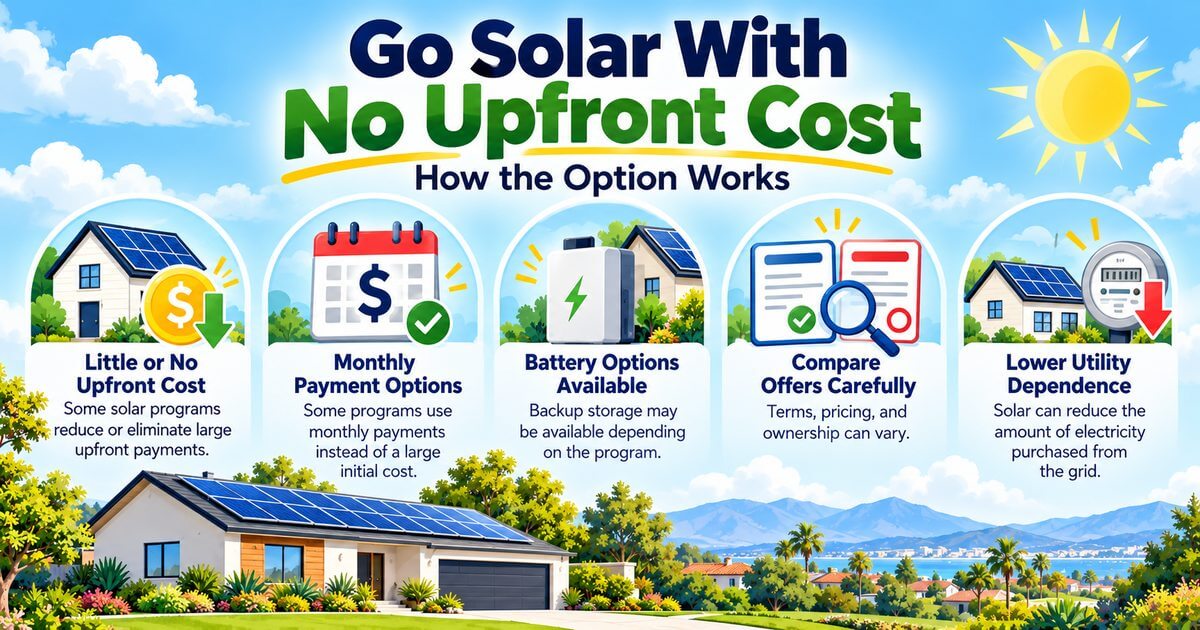
Many homeowners want solar but do not want to spend tens of thousands of dollars at the beginning of the project.
That is where a zero-upfront solar PPA or lease may help.
You may hear these programs described as “free solar.” Solar is not actually free. The homeowner enters into a long-term agreement and makes payments over time instead of buying the entire system at installation.
In return, the homeowner may receive:
- Little or no upfront installation cost
- Predictable electricity or lease payments
- A choice between a zero escalator and an annual escalator, when available
- Monitoring, maintenance, and covered repairs
- Equipment replacement when required by the agreement
- A process for transferring the agreement when the home is sold
- Solar and battery storage without making a large initial purchase
A long-term agreement is not automatically a bad thing. For the right homeowner, it can provide predictable energy costs, service coverage, and protection from certain future equipment expenses.
The important part is understanding the contract before signing it.
Home Pro Roofing and Solar works with several established solar installation and financing partners. This allows us to compare available PPA, lease, ownership, financing, and prepaid options instead of forcing every homeowner into one program.
Updated July 2026
Is “Free Solar” Really Free?
No.
The Federal Trade Commission warns homeowners to be cautious when someone claims that solar panels are completely free or that a government program will pay the entire cost. Solar equipment, labor, permits, financing, service, and maintenance all have a cost.
What a reputable solar company may offer is:
Solar with little or no upfront payment.
Instead of purchasing the system at installation, the homeowner signs a long-term PPA or lease.
The solar provider owns the equipment and recovers its investment through the homeowner’s payments over the agreement term.
“No upfront cost” means:
- You may not make a large payment when the system is installed.
- You will have a payment or energy charge during the contract.
- You usually will not own the equipment at the beginning.
- You are entering into a legally binding, long-term agreement.
- You must follow the contract’s rules when selling the home or ending the agreement.
It should never be presented as a government giveaway or a system that costs nothing.
What Is a Solar Power Purchase Agreement?
A solar Power Purchase Agreement, usually called a PPA, is an agreement where a third-party provider owns the solar system installed on the homeowner’s property.
The homeowner purchases the electricity produced by the system at a price stated in the agreement.
A PPA normally includes:
- An initial price per kilowatt-hour
- A contract term, often 20 to 25 years
- A zero escalator or annual escalator
- System monitoring
- Maintenance and covered repairs
- Production and performance terms
- Home-sale and transfer provisions
- Purchase or buyout options, when offered
The California Public Utilities Commission describes a PPA as an arrangement where the provider owns the system and sells the homeowner the electricity it generates. It states that typical PPA terms are 20 to 25 years.
The homeowner will usually continue receiving a bill from the electric utility. Solar may reduce utility electricity purchases, but it does not normally eliminate every utility charge.
What Is a Solar Lease?
A solar lease is similar to a PPA because a third party owns the equipment.
The main difference is how the homeowner pays.
With a lease, the homeowner generally pays a scheduled amount for the use of the solar system.
With a PPA, the homeowner generally pays for the amount of electricity the solar system produces.
The CPUC describes a lease as a program where the provider owns the system and rents it to the homeowner for scheduled monthly payments.
The exact payment structure can vary by provider. Always review the agreement instead of relying only on the words “lease” or “PPA.”
Solar PPA Versus Solar Lease
| Feature | Solar PPA | Solar Lease |
|---|---|---|
| Initial payment | Often little or no upfront payment | Often little or no upfront payment |
| How you pay | Usually based on the electricity produced by the solar system | Usually a scheduled payment for use of the equipment |
| Equipment owner | Third-party provider | Third-party provider |
| Typical agreement term | Often 20 to 25 years | Often 20 to 25 years |
| Annual escalator | May be zero or may increase annually, depending on the agreement | May be zero or may increase annually, depending on the agreement |
| Monitoring and maintenance | Usually handled by the provider, subject to the contract | Usually handled by the provider, subject to the contract |
| Home sale | Transfer, continuation, or buyout terms apply | Transfer, continuation, or buyout terms apply |
| End-of-term choices | Options may include renewal, purchase, or equipment removal | Options may include renewal, purchase, or equipment removal |
The exact terms matter more than the program name. Two PPAs from different providers may have different rates, escalators, service coverage, transfer requirements, and purchase options.
Home Pro reviews the available choices with the homeowner before a program is selected.
Why Homeowners Choose Zero-Upfront Solar
1. No Large Initial Purchase
The homeowner does not have to pay the full price of the solar and battery system at installation.
This can allow a homeowner to keep cash available for:
- Emergency savings
- Home repairs
- A roof replacement
- Education costs
- Retirement
- Other household priorities
The tradeoff is that the homeowner signs a long-term agreement and makes payments during the contract.
2. Predictable Energy Costs
A PPA or lease establishes the payment method in advance.
Depending on the program, the homeowner may choose:
- A zero escalator
- A fixed annual escalator
- A lower starting rate with future increases
- A higher starting rate with no annual increase
Predictable does not always mean flat.
A zero-escalator agreement generally keeps the PPA rate or lease payment from increasing each year under the scheduled agreement terms.
An escalator agreement starts with one rate and increases by the percentage stated in the contract.
The CPUC explains that PPA and lease payments may contain an annual escalator and recommends reviewing exactly how much and how often payments increase.
3. Monitoring and Maintenance
With a traditional PPA or lease, the third-party owner normally remains responsible for operating and maintaining the equipment.
Depending on the agreement, this may include:
- System monitoring
- Troubleshooting
- Covered labor
- Solar-panel repairs
- Inverter repairs or replacement
- Battery service or replacement
- Production issues
- Coordination with equipment manufacturers
The CPUC identifies provider monitoring, maintenance, and repairs as a common benefit of leases and PPAs.
The contract still controls. Do not assume that every service, failure, removal, or replacement is covered.
4. Protection From Certain Equipment Costs
Solar panels can operate for many years, but inverters and batteries may require service or replacement during a 20-to-25-year agreement.
With a homeowner-owned system, future costs may fall on the homeowner after the applicable warranty or labor coverage ends.
With a PPA or lease, the third-party owner may be responsible for keeping covered equipment operating during the agreement term.
Before signing, confirm:
- Whether battery repairs are covered
- Whether battery replacement is covered
- What level of battery capacity or performance is promised
- Whether labor is covered
- Whether shipping or service-call costs apply
- Whether replacement equipment must be new or may be equivalent
- What happens when a product is discontinued
- How quickly service requests must be handled
Do not accept a verbal promise that the battery is “covered for 25 years.” Ask to see the exact contract language.
5. Solar and Battery May Be Included Together
A zero-upfront program may include:
- Solar panels
- Inverters or microinverters
- Battery storage
- Backup equipment
- System monitoring
- Required electrical work
- Permitting and installation
- An eligible EV charger, depending on the program
Battery coverage and backup design vary.
A battery may be designed for:
- Bill savings only
- Essential-load backup
- Partial-home backup
- Whole-home backup
The proposal should clearly state what the battery can power during an outage.
6. A Transfer Process When the Home Is Sold
Many PPA and lease programs are designed to be transferred to a new homeowner.
That does not mean every transfer is automatic.
Depending on the agreement, the process may require:
- Advance notice to the provider
- Buyer paperwork
- Buyer acceptance of the agreement
- Financial qualification
- Escrow documents
- Payment of a processing fee
- A purchase or buyout instead of transfer
California’s Solar Consumer Protection Guide states that homeowners may need to transfer the agreement or buy it out when selling the home. It warns that buyouts can cost thousands of dollars, depending on the contract.
Ask to see the exact transfer section before signing.
Understanding Zero Escalator and Annual Escalator Options
An escalator is the amount the PPA electricity rate or lease payment increases each year.
Zero Escalator
A zero-escalator program generally means the scheduled PPA rate or lease payment does not increase annually.
Potential benefits include:
- Easier long-term budgeting
- No scheduled annual PPA-rate increase
- A clearer comparison with future utility rates
- Less payment growth over the agreement term
A zero-escalator option may begin at a higher rate than an escalating option.
Annual Escalator
An escalator program may begin with a lower first-year rate and increase each year.
Potential benefits include:
- Lower initial payments
- More immediate first-year savings
- A payment structure that may still increase more slowly than the homeowner expects utility prices to rise
The risk is that the payment continues increasing even when utility rates or household circumstances do not follow the original prediction.
Do not choose an escalator based only on the lowest first-year payment.
Review:
- The starting rate
- The annual percentage increase
- The payment in year 5
- The payment in year 10
- The payment in year 20
- The estimated total paid over the entire agreement
Savings projections are estimates, not guarantees. The CPUC notes that future electricity use, utility rates, solar production, and home-sale costs can all cause actual savings to differ from the estimate.
What Is the Difference Between a PPA Payment and a Utility Bill?
A PPA or lease does not normally replace every utility charge.
The homeowner may have:
- A PPA or lease payment
- A remaining electric utility bill
The utility bill may include:
- Electricity purchased from the grid
- Fixed customer charges
- Minimum charges
- Non-bypassable charges
- Other utility fees
- Charges for electricity used when the solar system is not producing enough
The PPA payment covers the solar electricity or leased equipment according to the agreement.
A proposal should show both expected costs, not only the PPA payment.
Is a 25-Year Agreement a Bad Thing?
Not necessarily.
A 25-year agreement may be a reasonable choice when the homeowner values:
- Little or no upfront cost
- Predictable energy pricing
- Long-term monitoring and service
- Covered equipment repairs
- Battery replacement protection, when included
- A defined home-sale transfer process
- Less responsibility for maintaining the system
The long term becomes a problem when the homeowner does not understand:
- The escalator
- Total payments
- Transfer requirements
- Purchase options
- End-of-term choices
- Equipment coverage
- Roof responsibilities
- Early-termination costs
The correct question is not simply:
“Is 25 years too long?”
The better question is:
“Are the rate, protections, responsibilities, and transfer terms reasonable for the full 25 years?”
What Happens if Solar Panels, Inverters, or Batteries Fail?
The answer depends on the contract.
A strong agreement should explain:
- Who monitors the system
- How the homeowner reports a problem
- Who pays for diagnosis
- Who pays for labor
- Whether the provider repairs or replaces failed equipment
- How battery failure is defined
- Whether reduced battery capacity qualifies for replacement
- Whether production is guaranteed
- How long the provider has to respond
- What happens when replacement equipment is unavailable
- Whether the homeowner receives a payment credit during extended downtime
Manufacturer warranties and PPA service obligations are not the same.
A manufacturer warranty may cover a product defect but not all labor, removal, shipping, permitting, or reinstallation costs.
The PPA or lease should state what the third-party owner must do when covered equipment fails.
The FTC recommends getting promises about warranties and repairs in writing rather than relying on verbal statements.
What Happens if You Sell Your Home?
Before signing, ask the provider to show you the exact contract section covering a home sale.
Common options may include:
- Transfer the agreement to the buyer
- Continue making the payments
- Purchase the system
- Buy out the remaining agreement
- Pay a transfer or processing fee
- Remove the system, if permitted under the contract
Ask these questions:
- Must the buyer qualify?
- Is there a transfer fee?
- How much notice is required?
- Who prepares the transfer documents?
- Can the system be purchased before the home is listed?
- How is a purchase price calculated?
- What happens if the buyer refuses the agreement?
- Is there an equipment-related filing that must be addressed?
- How long does the transfer process usually take?
- Who should the real estate agent or escrow company contact?
A transfer may be straightforward when it is started early. Waiting until the week of closing can create unnecessary delays.
What Happens at the End of the Agreement?
End-of-term options vary.
They may include:
- Renewing the agreement
- Purchasing the equipment
- Continuing under revised terms
- Having the provider remove the equipment
- Another option described in the contract
Do not assume the system automatically becomes yours at the end of a traditional PPA or lease.
Ask:
- Who owns the system at the end?
- Is there a purchase price?
- How is the purchase price calculated?
- Who pays for removal?
- Who repairs the roof after removal?
- What happens to the battery?
- Which warranties remain?
- How much notice must be given?
Solar PPA, Lease, Prepaid PPA, or Ownership?
| Option | Upfront Payment | Monthly Payment | Initial Owner | Best Fit |
|---|---|---|---|---|
| Monthly Solar PPA | Often little or none | Based on the electricity produced, subject to the agreement | Third-party provider | Homeowners who want low upfront cost, predictable energy pricing, and provider service coverage |
| Solar Lease | Often little or none | Scheduled lease payment | Third-party provider | Homeowners who prefer a scheduled equipment payment and long-term provider responsibility |
| Prepaid Solar PPA | One prepaid amount, paid with cash or financing | No monthly PPA payment. A separate loan payment applies when financed. | Third-party owner during the initial period | Homeowners who can pay or finance one prepaid amount and want approximately 30% upfront program savings under Home Pro's current options |
| Cash Purchase | Full purchase price | No solar payment | Homeowner | Homeowners who want immediate ownership and can pay the project price |
| Solar Loan | Varies by lender | Monthly loan payment | Homeowner | Homeowners who want ownership but prefer to spread the purchase cost over time |
Home Pro can compare these choices using the same solar and battery design. This makes it easier to see the real differences in cost, ownership, service coverage, and long-term responsibilities.
Want Upfront Savings Without a Monthly PPA Payment?
A traditional PPA or lease is designed for homeowners who want to pay little or nothing upfront.
Homeowners who can make or finance one initial payment may also consider Home Pro’s Prepaid Solar PPA.
Home Pro’s current prepaid programs may provide approximately 30% upfront savings compared with a similar direct purchase.
The homeowner makes one prepaid payment and has:
- No monthly solar PPA payment
- No annual PPA escalator
- Solar and battery options
- A path to homeowner ownership beginning in year six, subject to the signed agreement
The Prepaid Solar PPA is not a zero-upfront option unless the prepaid amount is financed with terms that require no down payment.
It is an alternative for homeowners who want the program savings but do not want a traditional 20-to-25-year monthly PPA payment.
What About the Residential Solar Tax Credit?
The homeowner Residential Clean Energy Credit is not available for qualifying property placed in service after December 31, 2025.
With a traditional PPA or lease:
- The homeowner does not own the equipment.
- The homeowner does not personally claim the residential solar tax credit.
- The third-party system owner may qualify for available business incentives.
- The provider may reflect some of that value in the PPA or lease pricing.
The homeowner should compare the actual payment terms rather than assuming that a tax benefit automatically makes one option better than another.
Home Pro does not provide tax advice. Consult a qualified tax professional with questions about your situation.
Solar and Battery With No Upfront Cost
A monthly PPA or lease may allow homeowners to install solar and battery storage without paying the full equipment price upfront.
This can reduce the risk of future battery expenses when the agreement places covered maintenance and replacement responsibility on the third-party owner.
The agreement should clearly state:
- Which battery is included
- Its usable capacity
- Which loads it can support
- Whether it provides outage backup
- Who monitors it
- What performance level is required
- What happens when capacity declines
- Whether replacement is included
- Who pays labor and permit costs
- Whether replacement coverage lasts for the entire agreement
Do not assume every battery failure or capacity reduction qualifies for a free replacement.
Make Sure the Roof Is Ready for Solar
A 20-to-25-year solar agreement should not begin with panels installed over a roof that will soon need replacement.
Before installing solar, review:
- Roof age and condition
- Existing leaks
- Shingle wear
- Roof-deck condition
- Flashing
- Ventilation
- Remaining roof life
- Solar attachment locations
If the roof needs replacement several years after solar is installed, the panels may need to be removed and reinstalled.
The PPA or lease should explain:
- Who can remove the equipment
- Whether provider approval is required
- Who pays removal and reinstallation
- Whether the provider must use its own contractor
- How roof work affects system warranties
- What happens if equipment is damaged
Home Pro can coordinate roof replacement, solar, and battery storage when the projects are planned together.
Questions to Ask Before Signing a PPA or Lease
- Is this a PPA or a lease?
- How long is the agreement?
- Is there an upfront payment?
- What is the first-year payment or electricity rate?
- Is there an annual escalator?
- What will the payment be in years 5, 10, 15, and 20?
- What is the estimated total paid over the entire term?
- Who owns the equipment?
- Who monitors the system?
- Who handles repairs?
- Are labor and service-call costs covered?
- Is battery replacement included?
- How is battery failure defined?
- Is there a production guarantee?
- What happens during extended system downtime?
- What happens if I sell my home?
- Must the buyer qualify?
- Is there a transfer fee?
- Can I purchase the system early?
- How is the purchase price calculated?
- What happens at the end of the agreement?
- Who pays to remove the equipment?
- Who repairs the roof after removal?
- What happens if the roof needs replacement during the term?
- Are all promises written in the agreement?
The CPUC advises homeowners to review total costs, annual increases, early termination, home-sale provisions, monitoring, and maintenance before signing.
Who Is Zero-Upfront Solar Best For?
A monthly PPA or lease may be a strong fit for a homeowner who:
- Does not want to make a large upfront payment
- Wants predictable energy costs
- Values long-term monitoring and service
- Wants covered repairs and equipment support
- Is comfortable with third-party ownership
- Understands the agreement term
- Has reviewed the escalator
- Understands the transfer and purchase options
- Wants solar and battery storage together
- Plans to remain in the home or is comfortable with the transfer process
When a PPA or Lease May Not Be the Best Choice
A PPA or lease may not be the best fit when:
- You want to own the system from the first day.
- You do not want a long-term agreement.
- You plan to sell very soon.
- You are uncomfortable with transfer requirements.
- You want full control over equipment changes.
- The escalator produces a high long-term cost.
- The estimated savings are too small.
- You do not understand the buyout terms.
- The roof will likely need replacement soon.
- A cash purchase, loan, or Prepaid Solar PPA offers a better fit.
Home Pro should compare the available choices rather than assume one program works for every homeowner.
Why Work With Home Pro Roofing and Solar?
Home Pro has served local homeowners since 2006.
We coordinate:
- Roof replacement
- Solar installation
- Battery backup
- EV chargers
- Solar removal and reinstallation
- Monthly PPAs
- Solar leases
- Prepaid Solar PPAs
- Cash and loan options
Home Pro works with more than one installation and financing partner. That allows us to review available programs and recommend an option based on the homeowner’s energy use, roof condition, battery goals, budget, and ownership preference.
Home Pro serves homeowners throughout Santa Clara and San Mateo counties.
Santa Clara County: Sunnyvale, Mountain View, Los Altos, Los Altos Hills, Saratoga, Palo Alto, Cupertino, Santa Clara, and San Jose.
San Mateo County: Menlo Park, Redwood City, San Carlos, Belmont, Foster City, and San Mateo.
Frequently Asked Questions About Zero-Upfront Solar
Is zero-upfront solar actually free?
No. The homeowner does not pay the full system price at installation but signs a long-term agreement with scheduled payments or electricity charges. Solar should not be marketed as a free government program.
What is the difference between a PPA and a solar lease?
With a PPA, the homeowner generally pays for the electricity the system produces. With a lease, the homeowner generally makes a scheduled payment for the use of the equipment. The third-party provider owns the system under both arrangements.
How long is a solar PPA or lease?
Many residential solar PPAs and leases run for approximately 20 to 25 years. The exact term is listed in the agreement.
What is a solar escalator?
An escalator is a scheduled annual increase in the PPA rate or lease payment. Some programs offer a zero escalator, while others begin at a lower rate and increase each year.
Who repairs the solar system?
The third-party owner usually handles monitoring, maintenance, and covered repairs. The exact equipment, labor, battery, and replacement coverage depends on the signed agreement.
Is battery replacement included?
It may be included, but coverage varies by program. The homeowner should review how battery failure is defined, what performance is promised, and whether labor and replacement costs are covered.
Can I sell my home with a PPA or lease?
Yes, but the agreement must be addressed. Depending on the contract, the homeowner may transfer it to the buyer, continue making payments, or purchase or buy out the system.
Will the buyer need to qualify?
Some programs require buyer approval, paperwork, or financial qualification. Others may use a simpler transfer process. The specific agreement controls.
Can I buy the system later?
Many programs offer purchase options at certain times. The purchase price and available dates vary and should be reviewed before signing.
Will solar completely eliminate my utility bill?
Usually not. Homeowners may continue paying fixed utility charges and for electricity purchased from the grid when solar and battery production do not cover household use.
Is there a zero-upfront option with no escalator?
Some programs offer a zero escalator. Availability and starting rates depend on the provider, project, credit approval, utility, and current program terms.
How is the Prepaid Solar PPA different?
The Prepaid Solar PPA requires one prepaid amount instead of long-term monthly PPA payments. Home Pro’s current programs may provide approximately 30% upfront savings, no monthly PPA payment, and a path to ownership beginning in year six, subject to the agreement.
The Bottom Line
A solar PPA or lease can allow a homeowner to install solar and battery storage without making a large upfront purchase.
It is not free solar.
The homeowner exchanges a large initial purchase for a long-term agreement that may provide:
- Little or no upfront cost
- Predictable energy payments
- Zero-escalator or escalator choices
- Monitoring and service
- Covered repairs
- Equipment replacement when included
- Battery protection when included
- A home-sale transfer process
- Less responsibility for maintaining the system
The agreement should be judged by its full 20-to-25-year terms, not only the first-year payment.
Home Pro Roofing and Solar can compare a monthly PPA, lease, Prepaid Solar PPA, cash purchase, and solar loan using the same system design and equipment.
Learn more about Home Pro’s solar and battery services, review our solar payment options, or request a free solar consultation.
Call (800) 650-3134.
This article provides general educational information. PPA, lease, service, transfer, purchase, utility, and equipment terms vary by provider and may change. Review the current proposal and signed agreement before making a decision.