
Going solar changed in 2026. California homeowners who purchase a solar system directly can no longer count on the old 30% Residential Clean Energy Credit for a new system placed in service after December 31, 2025. The IRS confirms that the homeowner credit is no longer available for systems placed in service after that date.
That does not mean homeowners have lost every opportunity for meaningful upfront savings.
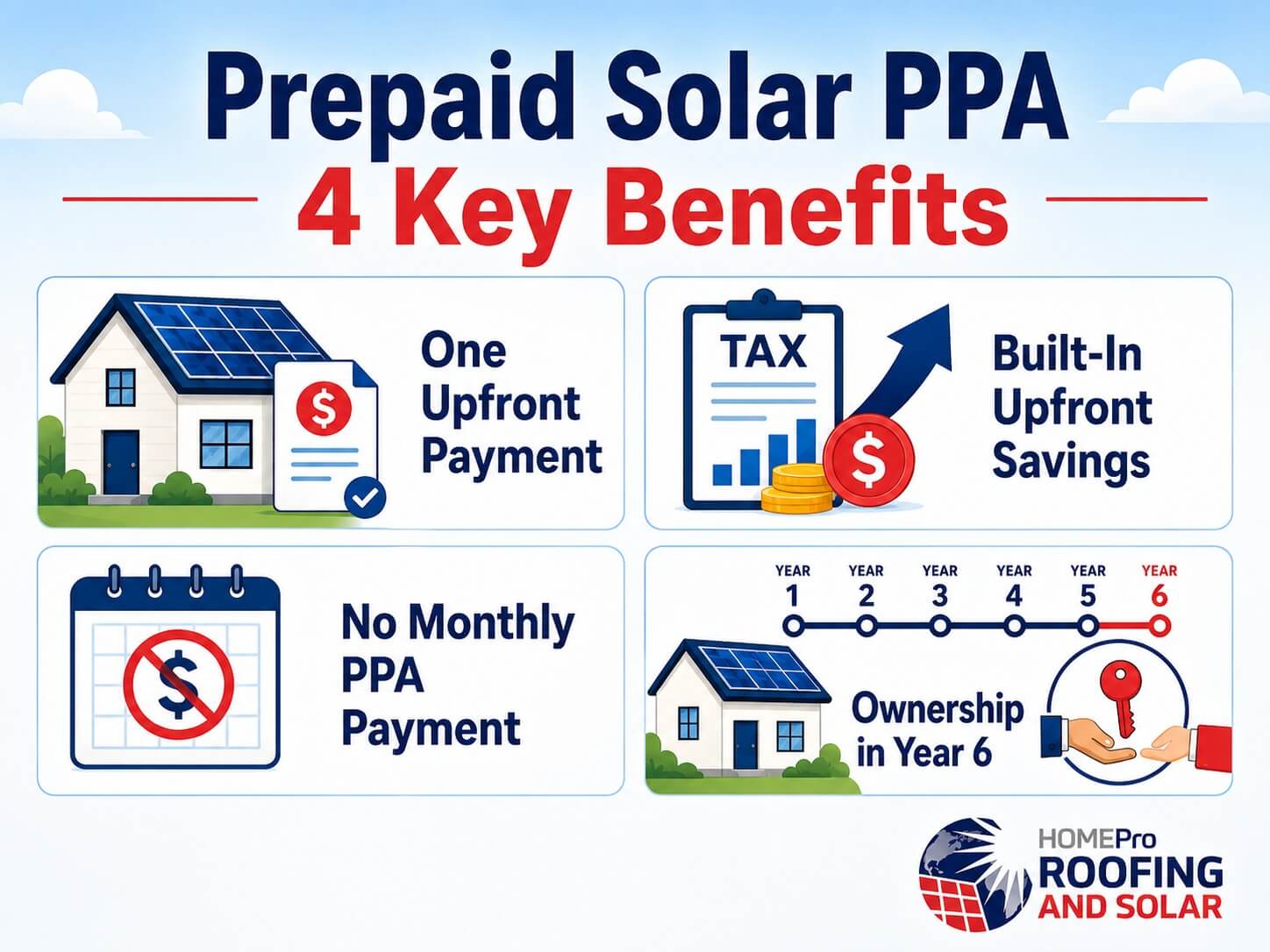
Home Pro currently offers Prepaid Solar PPA programs that can provide approximately 30% upfront savings compared with a similar direct purchase. The homeowner makes one prepaid program payment, either with cash or financing, and does not have a monthly PPA payment or annual PPA increase.
The system is owned by a third-party program owner during the first five years. The program owner may use available business clean-energy tax benefits, and that value is reflected in the lower prepaid price offered to the homeowner.
Home Pro’s current programs also provide a path to homeowner ownership beginning in year six. The exact legal wording and transfer process depend on the signed agreement.
This article explains the seven main reasons a Prepaid Solar PPA has become one of the strongest ways to go solar in California in 2026.
What Is a Prepaid Solar PPA?
A Prepaid Solar PPA is a third-party-owned solar program in which the homeowner prepays the program amount at the beginning instead of making monthly PPA payments for many years.
The prepaid amount may be paid with cash or financed through a separate lender.
The basic structure is:
- Solar is installed on the homeowner’s property.
- A third-party program owner owns the equipment during the initial period.
- The homeowner prepays the program amount.
- The homeowner uses the electricity produced by the system.
- There is no monthly solar PPA payment or annual PPA escalator.
- The installer and program owner handle covered system issues during the initial ownership period.
- Home Pro’s current programs provide a path to homeowner ownership beginning in year six.
Depending on the program, the legal documents may use terms such as prepaid PPA, prepaid lease, or customer participation agreement. The exact agreement is more important than the name used to describe it.
Homeowners should review the ownership, service, transfer, equipment-filing, home-sale, and year-six purchase terms before signing.
Benefit 1: Approximately 30% Upfront Savings
The largest benefit is the lower prepaid price.
Home Pro’s current Prepaid Solar PPA programs can provide approximately 30% upfront savings compared with a similar direct cash purchase. The exact amount depends on the system design, included equipment, project eligibility, and program available when the agreement is signed.
The homeowner does not personally claim a 30% residential tax credit. Instead, the third-party program owner may use available business clean-energy tax benefits. The value of those benefits is reflected in the prepaid program price.
For example, a homeowner comparing two similar systems may see:
- A higher price for a direct cash purchase
- A lower prepaid amount through the Prepaid Solar PPA
- Similar solar and battery equipment
- No need to wait for a personal tax refund
The actual comparison should always use the same system size, equipment, battery capacity, electrical work, and installation scope.
A low price is not meaningful if one proposal includes less equipment or leaves out important work.
Benefit 2: No Personal Tax Credit Claim or Waiting for a Refund
Under the old residential credit, homeowners generally had to purchase an eligible system, place it in service, file the required tax forms, and have enough tax liability to use the credit.
That homeowner credit is not available for new residential systems placed in service after December 31, 2025.
With Home Pro’s Prepaid Solar PPA, the homeowner does not file for the solar tax credit.
Instead:
- The program savings are reflected in the prepaid price.
- There is no homeowner solar-credit application.
- The homeowner does not wait until tax season to see the benefit.
- The benefit does not depend on the homeowner personally having enough federal income-tax liability to use a residential solar credit.
This can make the program easier to understand. You compare the prepaid price with the price of buying a similar system directly.
Benefit 3: No Monthly PPA Payment or Annual Escalator
A traditional monthly PPA normally charges the homeowner for the electricity produced by the solar system. Some monthly agreements also increase the payment or electricity rate each year.
A Prepaid Solar PPA works differently.
The program amount is prepaid at the beginning. That means there is:
- No monthly solar PPA payment
- No annual PPA payment increase
- No monthly charge based on how many kilowatt-hours the system produces
The homeowner may still receive an electric bill from the utility. Solar does not normally eliminate every utility charge, and actual savings depend on energy use, system production, battery operation, and the applicable utility rate plan.
A homeowner who finances the prepaid amount will have a payment to the separate lender. That is a loan payment, not a monthly PPA payment.
This distinction is important. “No monthly PPA payment” does not mean “no payment of any kind” when the prepaid amount is financed.
Benefit 4: The Lower Prepaid Amount Can Be Financed
A homeowner does not necessarily need enough cash to pay the full prepaid amount at once.
The prepaid amount may be financed through an approved lender or another eligible financing source.
Because the prepaid program price currently reflects approximately 30% upfront savings, the amount financed may be lower than the cost of financing a similar system purchased directly.
A lower starting balance may result in:
- A lower loan amount
- A lower monthly loan payment
- Less total interest, depending on the rate and term
- A shorter practical payoff period
- More flexibility for homeowners who want to keep cash available
Financing terms still matter. Homeowners should compare:
- Interest rate
- Loan term
- Lender fees
- Dealer fees
- Prepayment rules
- Total of all payments
- Whether the loan is secured or unsecured
- Whether any tax deductions are being assumed
The lowest monthly payment is not always the lowest total cost.
Home Pro can compare the prepaid program with cash, loans, monthly PPAs, leases, and other available options.
Benefit 5: Solar, Battery Storage, and an EV Charger May Be Included
Home Pro’s current Prepaid Solar PPA programs may include more than solar panels.
Depending on the project and program eligibility, the prepaid system may include:
- Solar panels
- Inverters and solar equipment
- Battery storage
- Required solar electrical work
- A Level 2 EV charger
- Eligible installation and permitting costs
This can be especially valuable for homeowners who want solar and battery storage together.
Under California’s Net Billing Tariff, commonly called NEM 3.0, extra daytime solar sent to the grid is often worth less than electricity used directly in the home. Battery storage can save daytime solar energy for evening use, when solar panels are no longer producing. The CPUC designed the tariff in part to encourage solar systems paired with storage.
A battery may also provide backup power when properly designed and installed for that purpose.
Not every homeowner needs the same battery system. The correct design depends on:
- Household electricity use
- Utility company
- Rate plan
- Desired backup loads
- Electric vehicle charging
- Available electrical capacity
- Solar-system size
- Budget
Roof replacement is generally separate from the Prepaid Solar PPA. Home Pro can coordinate the roofing and solar projects, but the roof should not be presented as receiving the same prepaid solar-program savings unless the written proposal specifically says so.
Benefit 6: System Support During the Initial Ownership Period
During the first five years, the third-party program owner owns the solar equipment.
Covered system issues during this period are handled through the installer and the program owner, based on the signed agreement and applicable manufacturer warranties.
This may reduce the homeowner’s early risk because the installer and program owner remain involved while the system is operating under third-party ownership.
Before signing, homeowners should confirm:
- Who monitors system production
- Who receives system alerts
- Who the homeowner contacts for service
- Which labor is covered
- Which equipment warranties apply
- How battery problems are handled
- Whether there are service-call charges
- What happens if equipment must be replaced
- What responsibilities move to the homeowner after ownership changes
Do not assume that every repair or replacement is covered forever.
Manufacturer warranties, installer obligations, program coverage, and homeowner responsibilities may be different. The written agreement should clearly explain each one.
Benefit 7: A Path to Homeowner Ownership Beginning in Year Six
Many homeowners do not want a third party to own the system for 20 or 25 years.
Home Pro’s current prepaid programs provide a path for the homeowner to take ownership beginning in year six, after the initial third-party ownership period.
Once ownership changes, the system becomes a homeowner-owned asset, subject to the terms of the transfer documents and any remaining manufacturer warranties.
The exact legal wording differs between programs. One agreement may describe a purchase or transfer using fair-market-value language, while supporting program documents may explain how the year-six transfer is intended to work.
For that reason, Home Pro will review the following before the homeowner signs:
- When the ownership option becomes available
- Whether the homeowner must request the transfer
- Whether there is a deadline to act
- What transfer documents are required
- How the transfer amount is described
- Whether any equipment filing must be released
- Which warranties continue after the transfer
- Who handles service after the homeowner owns the system
The safest approach is to understand the year-six process when purchasing the system, not five years later.
Prepaid Solar PPA Compared With Other Solar Options
| Feature | Prepaid Solar PPA | Direct Cash or Loan Purchase | Monthly PPA or Lease |
|---|---|---|---|
| Starting cost | One prepaid amount that currently may provide approximately 30% upfront savings compared with a similar direct purchase | Full purchase price paid with cash or financed with a loan | Often little or no upfront payment |
| Monthly solar payment | No monthly PPA payment. A separate loan payment applies if the prepaid amount is financed. | No solar payment with cash. Monthly lender payment when financed. | Monthly PPA or lease payment |
| Annual payment increase | No annual PPA escalator | Loan payment is based on the loan terms | May include an annual escalator, depending on the agreement |
| Initial system owner | Third-party program owner during the initial period | Homeowner from the beginning | Third-party owner, usually for the agreement term |
| Path to ownership | Home Pro's current programs provide an ownership option beginning in year six, subject to the signed agreement | Already owned by the homeowner | Purchase options vary and may be based on fair market value |
| Solar, battery, and EV charger | May be included in the prepaid program, subject to eligibility | Purchased at the homeowner's cost | Availability depends on the provider and agreement |
| Home sale | Transfer and purchase options depend on the program agreement | Loan balance and any equipment filing must be addressed | Buyer transfer, qualification, or purchase terms may apply |
The best option depends on the homeowner’s available cash, financing cost, desired ownership date, time in the home, and willingness to accept third-party ownership during the initial period.
Home Pro compares the available choices using the same system size and equipment so homeowners can see the real differences.
What Happens if You Sell the Home Before Year Six?
Selling before year six does not automatically mean the solar system must be removed or that the home cannot be sold.
A transfer process may be available, but the exact rules depend on the signed program agreement.
Depending on the program, the process may include:
- Giving the program owner advance notice
- Transferring the agreement to the buyer
- Having the buyer sign transfer documents
- Addressing an equipment filing
- Requesting an available purchase option
- Coordinating documents through the closing or escrow process
Do not assume every program has the same buyer qualifications, fees, transfer process, or purchase option.
Before signing a Prepaid Solar PPA, ask Home Pro to show you the section that explains what happens if the home is sold during the first five years.
If you later decide to sell, contact Home Pro before listing the home so the transfer documents can be reviewed early.
Who Is a Prepaid Solar PPA Best For?
A Prepaid Solar PPA may be a strong fit for a homeowner who:
- Wants approximately 30% upfront savings compared with a similar direct purchase
- Has cash available or can finance the prepaid amount
- Does not want a monthly PPA payment
- Does not want an annual PPA escalator
- Wants solar and battery storage together
- May want to include an EV charger
- Is comfortable with third-party ownership during the first five years
- Wants a path to ownership beginning in year six
- Understands the home-sale and transfer process
- Wants Home Pro to compare several payment options
It may also be useful for a homeowner who would not have been able to use the former residential tax credit because of limited federal income-tax liability.
When a Prepaid Solar PPA May Not Be the Best Choice
A Prepaid Solar PPA may not be the best fit when:
- You want to own the system from the first day.
- You do not want any third-party ownership period.
- You want a true zero-upfront monthly program.
- You plan to sell very soon and do not want transfer paperwork.
- You cannot pay or finance the prepaid amount.
- You want only a roof replacement without solar, battery storage, or another eligible energy component.
- You do not understand the ownership or transfer language.
- Another payment option produces a lower total cost for your situation.
A good solar proposal should compare the choices honestly. The prepaid option may be very strong in 2026, but it should still be evaluated against the homeowner’s goals.
Why Work With Home Pro Roofing and Solar?
Home Pro Roofing and Solar has served local homeowners since 2006.
We coordinate:
- Roof replacement
- Solar installation
- Battery backup
- EV charger installation
- Solar-panel removal and reinstallation
- Cash, loan, monthly PPA, lease, and prepaid options
This matters because the roof, solar attachments, electrical system, battery, permitting, and financing must work together.
If the roof needs replacement before solar is installed, Home Pro can coordinate the roofing and solar schedules. The projects will still have their own applicable permit and inspection requirements, but the homeowner has one point of contact coordinating the work.
Home Pro currently serves homeowners throughout Santa Clara and San Mateo counties, including Sunnyvale, Mountain View, Los Altos, Palo Alto, Cupertino, Santa Clara, San Jose, Menlo Park, Redwood City, San Carlos, Belmont, Foster City, and San Mateo.
Frequently Asked Questions About Prepaid Solar PPAs
Does the homeowner receive a 30% federal solar tax credit?
No. The homeowner does not personally claim a 30% residential solar tax credit for a new system placed in service in 2026.
Home Pro’s current Prepaid Solar PPA programs use a different third-party ownership structure. The program owner may use available business clean-energy tax benefits, and the value is reflected in a prepaid price that can currently provide approximately 30% upfront savings compared with a similar direct purchase.
Do I make a monthly PPA payment?
No. The program amount is prepaid at the beginning, and there is no monthly PPA payment or annual PPA escalator.
When the prepaid amount is financed, the homeowner makes payments to the separate lender according to the loan agreement.
Who owns the solar system during the first five years?
A third-party program owner owns the system during the first five years. The homeowner uses the electricity the system produces.
Covered service issues during this period are handled through the installer and program owner, subject to the signed agreement and equipment warranties.
What happens in year six?
Home Pro’s current programs provide a path for the homeowner to take ownership beginning in year six.
The exact legal wording, request process, deadlines, documents, and transfer terms vary by program. Home Pro reviews those terms with the homeowner before signing.
Can I sell my home before year six?
A transfer process may be available, but the exact steps depend on the agreement.
The buyer may be able to take over the agreement after the required notice and paperwork. Other options may also be available. Homeowners should review the sale and transfer section before signing and contact Home Pro before listing the property.
Can battery storage and an EV charger be included?
Yes, Home Pro’s current programs may include solar panels, eligible battery storage, and an EV charger in the prepaid project, subject to program and project eligibility.
Does a Prepaid Solar PPA place a lien on my home?
Home Pro’s current prepaid programs are not presented as mortgage liens on the home. An equipment-related UCC filing may be used to document the third party’s ownership interest in the solar equipment during the initial period.
The exact filing and release terms must be confirmed in the signed agreement.
Is the roof included in the approximately 30% prepaid savings?
Generally, no. The Prepaid Solar PPA applies to eligible solar, battery, EV-charging, and related energy equipment included in the program.
Home Pro can coordinate a roof replacement with the solar project, but roofing costs should be listed separately unless the written program proposal states otherwise.
The Bottom Line
The end of the homeowner residential solar tax credit changed the way California homeowners should compare solar in 2026.
Home Pro’s Prepaid Solar PPA provides another option.
Depending on the project and current program terms, it may offer:
- Approximately 30% upfront savings
- No personal solar tax-credit claim
- No waiting for a tax refund
- No monthly PPA payment
- No annual PPA escalator
- The ability to finance the lower prepaid amount
- Solar, battery storage, and an EV charger in one eligible program
- System support during the initial ownership period
- A path to homeowner ownership beginning in year six
The signed agreement still matters. Homeowners should understand the service, ownership, equipment-filing, home-sale, and year-six transfer terms before moving forward.
Home Pro can compare a Prepaid Solar PPA with cash, a solar loan, a monthly PPA, or a lease using the same system design and equipment.
Learn more about Home Pro’s Prepaid Solar PPA, or request a free solar and battery consultation.
Call (800) 650-3134.
This article provides general educational information and is not tax, legal, investment, or financial advice. Program availability, savings, tax rules, equipment, financing terms, and contract terms can change. Review the current proposal and signed agreement before making a decision.