
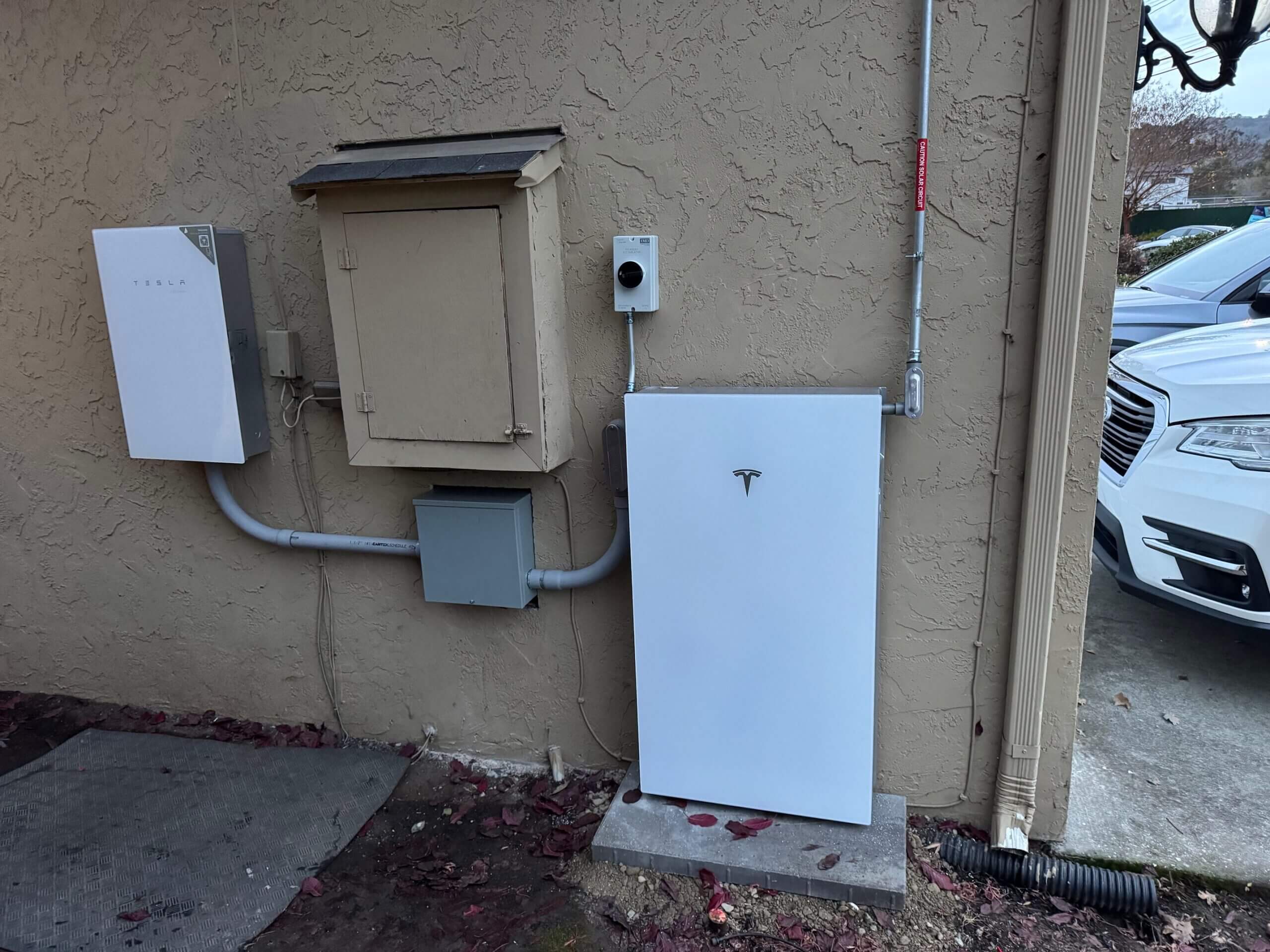
Home battery storage can do two important jobs. It can save solar energy for use later, and it can provide power during an outage.
Those jobs are related, but they are not the same.
A battery designed only to shift electricity use may not power your home when the grid goes down. Outage backup requires the proper controls, electrical equipment, and system design.
The right battery also depends on your utility company. Most homeowners in Santa Clara and San Mateo counties are served by PG&E, but Palo Alto and Santa Clara operate their own electric utilities. Their rates, solar rules, rebates, and battery economics are different.
Home Pro Roofing and Solar installs battery systems with new solar projects, adds storage to qualifying existing solar systems, and provides battery-only options when appropriate.
This guide explains the benefits, costs, equipment choices, utility rules, incentives, and questions homeowners should review before installing battery storage.
The Short Answer: Is Battery Backup Worth It in 2026?
For many homeowners, yes. But the reason matters.
A battery-backup system may be worthwhile when you want to:
- Use more of your own solar electricity
- Buy less electricity during higher-cost hours
- Reduce low-value daytime solar exports
- Keep important circuits running during an outage
- Support an electric vehicle or an all-electric home
- Add backup power to an existing solar system
- Reduce dependence on the electric grid
A battery may not be worthwhile when:
- Your electric use is very low
- Outage protection is not important
- Your utility rates provide little financial benefit for shifting energy
- The installation requires major electrical upgrades
- The battery is too small for the loads you expect it to support
- The total project cost is greater than the expected value
The decision should be based on your electric bills, utility rate plan, solar production, backup goals, available installation space, and total installed cost.
What Does a Home Battery Actually Do?
A home battery stores electricity so it can be used later.
The battery may charge from:
- Solar panels
- The electric grid
- A combination of solar and grid electricity, when allowed
How and when the battery charges depends on the system settings, utility rules, equipment, and homeowner goals.
Store Solar Energy for Evening Use
Solar panels often produce more electricity during the middle of the day than the home is using.
Without a battery, extra electricity may be sent to the utility grid. With a battery, some of that energy can be stored and used later, such as during the evening when the solar panels have stopped producing.
Under California’s Net Billing Tariff, export credits are usually lower than the retail price of electricity. The CPUC says battery storage can improve savings by allowing customers to use or export stored energy during higher-value hours.
Provide Power During an Outage
A properly designed backup system can separate the home from the utility grid and supply electricity from the battery during an outage.
The battery may support:
- Refrigerators and freezers
- Lights
- Internet equipment
- Selected outlets
- Garage doors
- Medical or accessibility equipment
- Heating controls
- A well pump or sump pump, when properly designed
- Air conditioning or other larger loads, when adequate capacity and output are installed
Backup power is not unlimited. Runtime depends on the battery’s usable capacity and the amount of electricity being used.
Large loads such as air conditioning, electric heat, ovens, clothes dryers, pool equipment, and EV charging can drain a battery much faster.
A Battery Does Not Automatically Provide Backup
Some battery projects are designed only to reduce grid purchases or shift electricity use.
These systems may shut down during an outage unless they include the required backup gateway, transfer equipment, controls, and electrical configuration.
The proposal should clearly state whether the battery provides:
- No outage backup
- Backup for selected essential circuits
- Partial-home backup
- Whole-home backup
Never assume that the word “battery” automatically means the entire home will remain powered.
Why Battery Storage Matters More Under PG&E’s Solar Billing Plan
Most new PG&E solar customers are placed on the Solar Billing Plan, also called the Net Billing Tariff or NEM 3.0.
Under this plan:
- Solar energy used immediately in the home reduces electricity purchased from the grid.
- Extra energy exported to the grid earns a separate export credit.
- Export values change by time of day and season.
- Daytime export credits are often lower than the retail cost of buying electricity.
- Stored electricity may be used or exported during higher-value hours.
PG&E states that the Solar Billing Plan is based on how much electricity the system generates, how much the home uses, and how much energy moves to and from the grid.
A battery can improve the value of a PG&E solar system by storing daytime production and using it later.
That does not mean every PG&E customer needs the largest battery available. The system should be designed around the homeowner’s actual electric use and goals.
Palo Alto and Santa Clara Require a Different Analysis
Not every local homeowner is a PG&E electric customer.
Battery Storage in Palo Alto
Palo Alto receives electricity from the City of Palo Alto Utilities.
PG&E’s Solar Billing Plan does not apply to Palo Alto customers in the same way. A proposal for a Palo Alto home should use Palo Alto’s actual rates and solar-credit rules.
The City of Palo Alto explains that a properly wired solar and battery system can provide power during an outage and can store unused solar electricity for later use.
For many Palo Alto homeowners, the strongest reason for a battery may be backup power and energy control rather than the same bill-savings calculation used for PG&E customers.
Battery Storage in Santa Clara
Santa Clara receives electricity from Silicon Valley Power.
Silicon Valley Power has its own electric rates, solar rules, interconnection process, and battery programs. PG&E assumptions should not be used for a Santa Clara proposal.
As of July 2026, Silicon Valley Power lists a battery-storage rebate of $0.15 per watt-hour, up to $2,700. Additional incentives may be available to qualifying lower-income customers. Program funding and eligibility can change, so current terms must be verified before signing a contract.
Six Main Benefits of Home Battery Storage
1. Use More of Your Own Solar Energy
A battery allows the home to store extra daytime solar production instead of immediately sending all of it to the grid.
That stored energy can be used after sunset, when the home would otherwise purchase more electricity from the utility.
2. Reduce Electricity Purchases During Expensive Hours
Time-of-use rates may charge more for electricity during certain hours.
A properly programmed battery can discharge during those periods, reducing the amount of higher-priced electricity purchased from the grid.
Actual savings depend on the utility, rate plan, battery settings, household use, and solar production.
3. Keep Important Loads Running During an Outage
A backup battery can keep selected circuits or the home operating when utility power is unavailable.
The project should be designed around the homeowner’s priorities. Keeping a refrigerator, lights, internet, and several outlets running requires much less energy than running central air conditioning, electric heating, an oven, and an EV charger.
4. Extend Backup Time With Solar Recharging
When a battery is paired with solar and configured for backup operation, the solar system may recharge the battery during daylight hours while the grid remains down.
Recharging depends on sunlight, weather, system design, battery state of charge, and household use.
A homeowner who uses less electricity during an outage will generally have more energy available for a longer period.
5. Support Future Home Electrification
Battery planning should account for future electrical loads, including:
- Electric vehicles
- Heat pumps
- Electric water heaters
- Induction cooking
- Pool equipment
- Accessory dwelling units
- Added air conditioning
- Home offices
A battery sized only around today’s use may be too small after the home adds major electrical equipment.
6. Reduce Reliance on the Grid
A battery does not make most homes completely independent of the utility.
However, solar and storage together can reduce the amount of electricity purchased from the grid and provide more control over when grid electricity is used.
Battery Project Options
| Project Type | Best Fit | Main Benefit | Important Planning Issue |
|---|---|---|---|
| New Solar Plus Battery | Homeowners installing a new solar system | Solar production, energy storage, and backup can be designed together | Roof condition, utility rate plan, system size, backup loads, and electrical capacity |
| Battery Added to Existing Solar | Homeowners who already have solar panels | Stores existing solar production and may add outage protection | Compatibility with the inverter, electrical system, monitoring, utility tariff, and existing equipment |
| Battery Without New Solar | Homeowners focused mainly on outage protection or time-of-use management | Can charge from the grid when permitted and provide stored electricity later | No solar is available to recharge the battery during a long outage |
| Prepaid Solar PPA With Battery | Homeowners installing new solar and battery storage who want lower upfront program pricing | Home Pro's current program may provide approximately 30% upfront savings compared with a similar direct purchase | Third-party ownership during the initial period and the ownership, transfer, maintenance, and home-sale terms in the signed agreement |
The best project type depends on whether the home already has solar, whether backup power is required, how much electricity the household uses, and how the homeowner wants to pay for the system.
How Much Does a Home Battery Cost?
There is no honest single price that applies to every battery project.
The total installed cost depends on more than the battery itself.
Important cost factors include:
- Battery brand and model
- Number of batteries
- Usable storage capacity
- Available power output
- Essential-load or whole-home backup design
- Backup gateway and transfer equipment
- Electrical panel condition
- Main-service capacity
- Required panel or service upgrades
- Length and location of wiring runs
- Indoor or outdoor installation
- Wall, floor, or concrete mounting requirements
- Fire and equipment clearances
- Permit and engineering requirements
- Integration with new or existing solar
- Load-management equipment
- Trenching or exterior conduit
- Utility interconnection work
Online battery prices often show only the equipment. They may leave out electrical work, controls, permits, installation labor, and system integration.
Home Pro provides a written proposal based on the actual home, equipment, and backup goals.
How Many Batteries Does a Home Need?
The answer depends on two separate measurements:
- How much electricity the batteries can store
- How much power they can provide at one time
A battery may have enough stored energy to run small loads for many hours but still be unable to start or operate several large appliances at the same time.
Before selecting the number of batteries, identify the loads you want available during an outage.
Essential-Load Backup
Essential-load backup may include:
- Refrigerator
- Freezer
- Internet
- Lights
- Selected outlets
- Garage door
- Heating controls
- Medical or accessibility equipment
This design usually requires less battery capacity than whole-home backup.
Partial or Whole-Home Backup
A broader backup plan may include:
- Air conditioning
- Electric heating
- Well pumps
- Kitchen appliances
- More household circuits
- Pool or spa equipment
- EV charging
Large loads may require additional batteries, higher power output, load-management controls, or limits on which appliances can operate together.
The phrase “whole-home backup” should never be used without a written explanation of what the system can actually support.
Battery Systems Home Pro Installs
Home Pro works with several established battery platforms, including:
Tesla Powerwall 3
Tesla Powerwall 3 can be used for solar storage, time-of-use management, and backup applications when installed with the proper controls and system design.
Qcells Battery Storage
Qcells battery systems can be paired with new Qcells solar projects and may be a good fit for homeowners who want an integrated solar and storage platform.
Enphase IQ Battery
Enphase battery systems can integrate well with homes using Enphase microinverters and may offer flexible system-sizing options.
The best battery is not always the most recognized brand.
The correct choice depends on:
- Existing solar equipment
- Desired backup loads
- Available installation space
- Battery capacity
- Power output
- Expansion options
- Monitoring
- Warranty
- Service support
- Total installed cost
Home Pro’s current battery service page identifies Tesla, Qcells, and Enphase as the main platforms offered.
Can You Add a Battery to an Existing Solar System?
Often, yes.
Home Pro can evaluate existing solar systems, including systems installed by another contractor.
The review should include:
- Panel and inverter equipment
- System age
- Existing utility tariff
- Electrical-panel capacity
- Available installation space
- Monitoring access
- Existing permits and plans
- Battery compatibility
- Desired backup loads
- Whether the original system is owned, financed, leased, or under a PPA
Adding a battery may require:
- City permits
- Electrical plans
- Utility paperwork
- A backup gateway
- A critical-load panel
- Wiring changes
- Inverter changes
- Updated monitoring
- Approval from a third-party system owner
Do not assume that every battery works with every existing solar system.
Can You Install a Battery Without Solar?
Yes, some batteries can charge from the electric grid without a new solar installation.
PG&E states that a home does not need solar to benefit from battery storage, although pairing the battery with solar may improve savings and make backup power last longer.
A battery-only project may make sense when:
- Outage protection is the main goal
- The roof is not suitable for solar
- The homeowner plans to add solar later
- The home already receives renewable electricity through its utility or CCA
- Time-of-use rate management provides enough value
The main limitation is recharge during an extended outage. Without solar, the battery cannot recharge from rooftop generation while utility power remains unavailable.
Battery Storage and the Prepaid Solar PPA
The homeowner Residential Clean Energy Credit is not available for battery or solar expenses after December 31, 2025. The IRS confirms that the residential credit ended for qualifying property placed in service after that date.
Home Pro’s current Prepaid Solar PPA offers a different structure.
Depending on the project and current program terms:
- Solar panels may be included.
- Battery storage may be included.
- An eligible EV charger may be included.
- The prepaid price may provide approximately 30% upfront savings compared with a similar direct purchase.
- The homeowner does not claim a personal residential solar tax credit.
- There is no monthly PPA payment or annual PPA escalator.
- The third-party program owner owns the equipment during the initial period.
- Home Pro’s current programs provide a path to homeowner ownership beginning in year six, subject to the signed agreement.
This option is mainly for homeowners installing a new solar and battery system. It is not the same as purchasing a stand-alone battery with cash or a traditional loan.
Battery Rebates and Financing Options
Available incentives depend on the utility, customer eligibility, project type, and remaining program funding.
Silicon Valley Power Battery Rebate
Silicon Valley Power currently lists:
- $0.15 per watt-hour
- Up to $2,700
- Potential additional incentives for qualifying lower-income customers
Program requirements and funding can change.
Cash, Loans, PPAs, and Other Financing
Home Pro can compare financing options:
- Cash purchase
- Traditional loan
- Prepaid Solar PPA
- Monthly PPA
- Solar lease
- PACE financing, where available
Compare the total cost, not only the first monthly payment.
Coordinate the Roof, Solar, and Battery Before Installation
A new battery does not normally require work on the roof, but a new solar and battery project should begin with a roof evaluation.
Installing solar over a roof that will soon need replacement can create future removal-and-reinstallation costs.
Before installing new solar and battery storage, review:
- Roof age and condition
- Remaining roof life
- Existing leaks
- Roof-deck condition
- Solar attachment locations
- Panel layout
- Conduit routes
- Battery location
- Electrical equipment
- Future EV charging
When the roof needs replacement, Home Pro can coordinate the roof, solar, battery, and electrical work as one planned project, while keeping the contracts, permits, inspections, and warranties clear.
Questions to Ask Before Buying a Home Battery
Ask the contractor:
- Is this system designed for bill savings, outage backup, or both?
- Which circuits will operate during an outage?
- Can the system run my air conditioner?
- How long might the battery last under my expected loads?
- Can solar recharge the battery while the grid is down?
- How many batteries are included?
- What usable capacity and power output are included?
- Is a backup gateway included?
- Is a critical-load panel required?
- Are electrical-panel upgrades included?
- Are permits and utility paperwork included?
- Is the battery compatible with my existing solar system?
- Can the system be expanded later?
- Which equipment and labor warranties apply?
- Who handles service after installation?
- Are rebate amounts guaranteed or only estimated?
- What is the total installed price?
- What happens if I sell the home?
- Who owns the battery?
- Which promises are written in the contract?
The proposal should clearly show what is included, what is excluded, and what could result in additional charges.
Why Work With Home Pro Roofing and Solar?
Home Pro has served local homeowners since 2006.
We coordinate:
- Roof replacement
- New solar installation
- Battery backup
- Battery additions to qualifying existing solar systems
- EV chargers
- Solar-panel removal and reinstallation
- Permits and inspections
- Financing and PPA options
The homeowner has one main point of contact instead of managing separate roofing, solar, battery, and electrical contractors.
Home Pro serves:
Santa Clara County: Sunnyvale, Mountain View, Los Altos, Los Altos Hills, Saratoga, Palo Alto, Cupertino, Santa Clara, and San Jose.
San Mateo County: Menlo Park, Redwood City, San Carlos, Belmont, Foster City, and San Mateo.
Frequently Asked Questions About Home Battery Backup
Will a battery power my entire home during an outage?
Possibly, but not every system is designed for whole-home backup. The answer depends on the number of batteries, available power output, electrical configuration, and loads being used. The proposal should list which circuits and appliances the system is designed to support.
How long will a battery last during an outage?
There is no single runtime that applies to every home. Runtime depends on battery capacity, household electricity use, weather, solar recharging, and which appliances are operating.
Can solar panels work during a power outage?
A standard grid-connected solar system normally shuts down during an outage for safety. Solar may continue operating and recharge batteries when the system includes compatible backup controls and is properly designed to operate separately from the grid.
Is a battery required under NEM 3.0?
No. A battery is not legally required for most residential solar projects. However, it may improve the value of a PG&E solar system by storing daytime production for later use.
Can I add a battery to my existing solar panels?
Often, yes. Compatibility depends on the inverter, electrical system, solar ownership, utility tariff, available space, and desired backup design.
Can I install a battery without solar panels?
Yes. Some batteries can charge from the grid. Without solar, however, the battery cannot recharge from rooftop generation during an extended outage.
Does a battery always provide outage backup?
No. A battery must include the proper gateway, transfer equipment, electrical controls, and system design to provide power while the utility grid is down.
Can a battery run central air conditioning?
Some systems can, but central air conditioning requires significant starting and operating power. The contractor must review the equipment and design the battery system around that load.
Is there still a federal homeowner tax credit for batteries in 2026?
No. The IRS states that the Residential Clean Energy Credit is not available for qualifying property placed in service after December 31, 2025. Home Pro’s Prepaid Solar PPA uses a different third-party ownership structure that may provide approximately 30% upfront program savings for eligible new solar-and-battery projects.
Which battery brand is best?
There is no single best brand for every home. Tesla, Qcells, and Enphase offer different equipment designs and integration options. The correct choice depends on the existing solar system, backup goals, capacity, power output, installation location, warranty, and total cost.
The Bottom Line
Battery storage can provide real value in 2026, but only when it is designed around the homeowner’s actual goals.
A strong battery project should clearly explain:
- Whether the goal is bill savings, outage backup, or both
- Which appliances and circuits will be supported
- How long the battery may last under expected use
- Whether solar can recharge it during an outage
- How the utility’s rates affect the savings
- Whether rebates are available
- What electrical work is required
- Who owns and services the equipment
- The full installed cost
PG&E, Palo Alto Utilities, and Silicon Valley Power customers should not all receive the same financial assumptions.
Home Pro Roofing and Solar can review your electric use, existing solar equipment, roof condition, backup priorities, utility company, and financing options to design a battery system that fits your home.
Learn more about Home Pro’s Battery Backup systems, request a free estimate, or call (800) 650-3134.
This article provides general educational information. Utility rates, rebates, equipment, tax rules, financing programs, and product availability can change. Review the current proposal, utility requirements, and signed agreement before making a decision.