
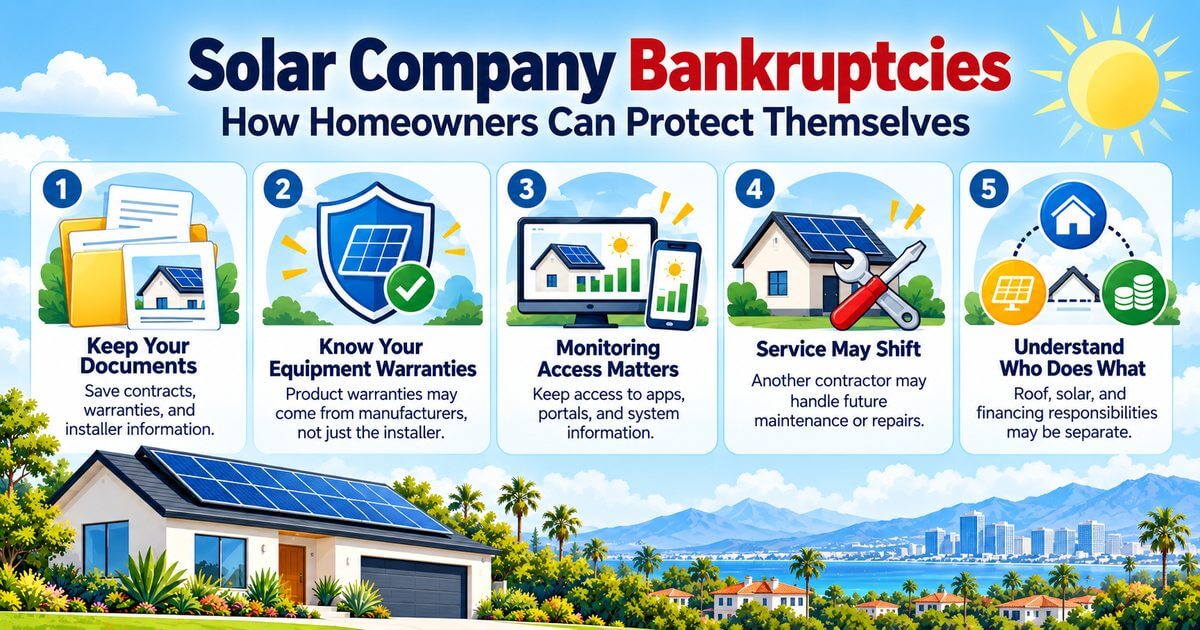
Solar companies can go out of business. Sometimes it is a large national installer. Sometimes it is a smaller local contractor. Either way, the homeowner is the one left trying to figure out who owns the system, who services the equipment, who honors the warranty, and what happens next.
This can be stressful, especially when the system is not working, the roof needs replacement, the original installer is gone, or the homeowner is still making loan, lease, or PPA payments.
The good news is that a closed solar company does not always mean the system is worthless. Manufacturer warranties may still apply. A lender, lease company, PPA owner, or equipment manufacturer may still have records. Another qualified contractor may be able to inspect, service, remove, or reinstall the system.
The key is knowing what documents to find, who to contact, and what to check before paying another contractor.
This guide explains what California homeowners should do if their solar company goes out of business, what warning signs to watch for before signing a solar or battery contract, and how Home Pro Roofing and Solar can help with roofing, solar, battery backup, and solar panel removal and reinstallation.
Updated July 2026
The Short Answer
If your solar company goes out of business, start by gathering your paperwork and identifying who owns each part of the project.
You need to know whether your system was:
- Purchased with cash
- Financed with a solar loan
- Installed under a monthly PPA
- Installed under a solar lease
- Installed under a prepaid PPA
- Connected to a battery-storage agreement
- Still covered by manufacturer warranties
- Still under a workmanship warranty from the installer
Then review:
- Your solar contract
- Financing, lease, or PPA agreement
- Permit records
- Utility interconnection documents
- Panel, inverter, and battery model numbers
- Monitoring login information
- Warranty documents
- Any roof warranty affected by the solar installation
Do not assume that every warranty disappeared. Also do not assume another contractor can work on third-party-owned equipment without approval.
The right next step depends on who owns the system and what problem you are trying to solve.
What Problems Can Happen When a Solar Company Closes?
When the original solar installer disappears, homeowners may face several different issues.
Unfinished Installation
Some homeowners are left with panels installed but not connected, permits not finalized, inspections not completed, or utility permission-to-operate still pending.
In that case, the project may need:
- Permit review
- Electrical inspection
- Utility paperwork
- System testing
- Corrections to pass inspection
- Help from the lender, PPA provider, or equipment owner
No Workmanship Warranty Support
Manufacturer warranties usually cover product defects. They do not always cover labor, troubleshooting, removal, shipping, permitting, or roof repairs.
If the installer is gone, the workmanship warranty may be difficult or impossible to use.
That matters because roof leaks, flashing problems, wiring issues, conduit problems, and poor mounting are often installation-related, not product defects.
Lost Monitoring or System Access
A homeowner may not know how to access the monitoring portal, reset the inverter, identify an error code, or confirm whether the system is producing power.
If the installer controlled the account, the homeowner may need help transferring monitoring access.
Equipment Failure
Panels, inverters, microinverters, batteries, breakers, and communication devices can fail.
A manufacturer may still provide part coverage, but the homeowner may need a qualified contractor to diagnose the issue, submit the claim, remove the failed equipment, and install the replacement.
Roof Replacement Complications
If the roof needs replacement, the solar panels usually need to be removed and reinstalled.
If the original installer is gone, the homeowner needs to know who can legally and safely handle the system.
This is especially important with leased systems, PPAs, and other third-party-owned equipment.
Ongoing Payments
A company going out of business does not automatically cancel a solar loan, lease, PPA, or prepaid agreement.
The homeowner may still owe payments to a lender or third-party system owner even if the original installer is gone.
Before stopping payments, homeowners should review the signed agreement and contact the lender or system owner.
First Steps if Your Solar Installer Is Gone
Start with the paperwork. It is much easier to solve a solar problem when you know what was installed, who owns it, and what agreements are still active.
Step 1: Find Your Solar Contract
Look for the original signed agreement.
It should identify:
- The contractor
- The equipment
- The price
- The financing method
- Warranty terms
- Scope of work
- Permits
- Expected production
- Cancellation and dispute terms
Step 2: Confirm How the System Was Paid For
The solution is different depending on the payment structure.
A cash-purchased system is usually homeowner-owned.
A financed system may be homeowner-owned, but a lender may have a UCC filing on the equipment.
A PPA or lease is usually third-party owned, with monthly payment options.
A prepaid PPA may have third-party ownership during an initial period, with a path to homeowner ownership later under the signed agreement.
Step 3: Find Permit and Utility Records
Look for:
- Building permits
- Electrical permits
- Solar plans
- Inspection cards
- Final inspection approval
- Utility interconnection documents
- Permission-to-operate confirmation
If you do not have these records, the city building department or utility may be able to help.
Step 4: Identify the Equipment
Write down or photograph:
- Solar panel brand and model
- Inverter or microinverter brand and model
- Battery brand and model
- Monitoring equipment
- Main panel or backup equipment
- Serial numbers, when accessible
Do not remove covers or open electrical equipment yourself.
Step 5: Contact the Current Responsible Party
Depending on your agreement, that may be:
- Equipment manufacturer
- Solar lender
- PPA provider
- Lease provider
- Monitoring company
- Bankruptcy claims administrator
- New company assigned to service the account
- Qualified local contractor
Do not rely only on the name of the original installer. The equipment, financing, or service rights may now belong to a different company.
What Homeowners Should Save Before There Is a Problem
| Document | Why It Matters |
|---|---|
| Solar contract | Shows the original scope, equipment, price, warranty, and contractor responsibilities. |
| Loan, lease, or PPA agreement | Explains ownership, payments, transfer rules, service coverage, purchase options, and home-sale requirements. |
| Solar plans and permits | Help a contractor understand the approved design and may be needed for future service or roof work. |
| Final inspection record | Shows whether the city approved the installation. |
| Utility approval | Confirms that the utility approved the system to operate. |
| Equipment model numbers | Needed for troubleshooting, warranty claims, monitoring access, and compatible replacement parts. |
| Monitoring login | Allows the homeowner or service provider to check system production and error messages. |
| Roof warranty | Important when solar attachments, roof leaks, or future panel removal are involved. |
Keep digital copies and printed copies. If the original contractor goes out of business, these records may be the difference between a simple service call and a long investigation.
Does the Manufacturer Warranty Still Apply?
Maybe.
Solar panels, inverters, and batteries often include manufacturer warranties. Those warranties may still exist even if the installer closed.
However, a manufacturer warranty is not the same as a complete service plan.
A manufacturer warranty may cover:
- Product defects
- Certain performance issues
- Replacement parts
- Equipment failure under warranty terms
It may not cover:
- Labor
- Diagnosis
- Shipping
- Roof access
- Permits
- Reinstallation
- Damage caused by poor installation
- Damage caused by roof leaks
- Monitoring problems
- Battery capacity outside the warranty terms
Homeowners should contact the manufacturer with model and serial numbers before assuming coverage is gone.
A qualified contractor may be needed to diagnose the problem and determine whether a manufacturer claim is realistic.
What Happens to a Solar Loan if the Installer Closes?
A solar loan usually remains active even if the installer goes out of business.
The lender is separate from the contractor. The homeowner’s payment obligation depends on the signed loan documents.
If the system was never completed or never turned on, contact the lender in writing and explain the issue. Provide:
- Contract
- Photos
- Permit status
- Inspection status
- Utility approval status
- Written communication with the installer
- Any proof that the system is not operating
Do not assume the loan will automatically stop. Ask the lender what dispute, holdback, or contractor-failure process is available.
What Happens to a Solar Lease or PPA?
With a solar lease or PPA, the homeowner usually does not own the equipment.
The third-party owner may still be responsible for monitoring, maintenance, repairs, or replacement under the agreement, even if the original installer is no longer involved.
The homeowner should review:
- Who owns the system
- Who receives payments
- Who handles service
- What production or performance guarantee applies
- How repairs are requested
- What happens if the provider changes
- What happens if the home is sold
- Whether roof work requires provider approval
Do not allow another contractor to remove or modify third-party-owned equipment until the agreement is reviewed and any required approval is received.
What if the Roof Needs Replacement?
This is one of the most common problems when an older solar system outlives the roof below it.
If the roof needs replacement, the solar panels usually must be:
- Shut down
- Disconnected
- Removed
- Stored safely
- Reinstalled
- Reconnected
- Tested
- Inspected, when required
The cost and approval process depend on who owns the system.
If the homeowner owns the system, the process is usually more direct.
If the system is leased or under a PPA, the system owner may need to approve the work. Some providers require specific contractors, forms, inspections, or fees.
Before starting a reroof, confirm:
- Who owns the solar equipment
- Whether written approval is required
- Whether the original provider still exists
- Whether the lender or PPA owner has requirements
- Whether permits are needed
- Who is responsible for roof leaks near solar mounts
- Whether old flashing or mounts should be replaced
Home Pro coordinates roof replacement and solar panel removal and reinstallation for homeowners throughout Santa Clara and San Mateo counties.
What if the Battery Stops Working?
Battery storage adds another layer of responsibility.
If the installer is gone, the homeowner needs to determine:
- Battery brand and model
- Whether the battery is owned, financed, leased, or part of a PPA
- Whether the manufacturer warranty still applies
- Whether the battery was installed with backup capability
- Whether the issue is the battery, inverter, gateway, wiring, monitoring, or settings
- Whether a qualified electrician or battery-certified installer is required
Do not assume that every battery problem means the battery itself failed.
Some issues come from incorrect settings, communication problems, grid events, software updates, load-panel wiring, or inverter compatibility.
A qualified battery contractor can help determine what is wrong and what coverage may apply.
Warning Signs Before You Sign a Solar or Battery Contract
This is where the “cheap solar” lesson matters.
A low price is not always a bad thing. But an incomplete price can become very expensive later.
Red Flag 1: “Free Solar” Claims
Be careful if a salesperson says the system is completely free.
The CPUC warns that solar is rarely free and that honest companies should explain the costs paid over time. The Federal Trade Commission also warns homeowners to be cautious with solar claims that sound too good to be true.
A zero-upfront PPA or lease may be legitimate, but it is not the same as free equipment.
Red Flag 2: Pressure to Sign Immediately
Do not sign because someone says the price is only available today.
The CPUC warns homeowners not to sign under pressure and says customers should be given time to review the guide and contract before signing.
Red Flag 3: No CSLB License Number
In California, you should verify the contractor’s license before signing.
The CPUC recommends checking the contractor’s CSLB license and, if applicable, the salesperson’s Home Improvement Salesperson registration. It also states that valid solar providers should hold the appropriate C-46, C-10, or B classification.
Red Flag 4: The Roof Is Ignored
Solar should not be sold without looking at the roof.
Ask:
- Is the roof old?
- Does it leak?
- Will it need replacement soon?
- What happens if panels must be removed later?
- Who pays for removal and reinstallation?
- Will the roof warranty be affected?
The CPUC specifically advises homeowners to consider roof condition before installing rooftop solar.
Red Flag 5: Missing Battery Details
If a battery is included, the proposal should state:
- Battery model
- Usable capacity
- Backup capability
- What circuits are backed up
- Whether whole-home backup is included
- Whether replacement is covered
- Who provides service
- What happens if capacity declines
“Battery included” is not enough.
Red Flag 6: The Cheapest Price Has an Incomplete Scope
A very low quote may leave out:
- Permits
- Electrical-panel work
- Battery gateway
- Backup wiring
- Roof repairs
- Solar panel removal and reinstallation
- Production monitoring
- Workmanship warranty
- Service labor
- Final inspections
- Utility paperwork
If the scope is not the same, the prices cannot be compared. How to compare roofing and solar quotes.
How to Protect Yourself Before Choosing a Solar Contractor
Verify the License
Use the CSLB Check a License tool. Confirm the company name, license number, status, bond, workers’ compensation, and license classification.
Ask Who Will Actually Install the System
Some companies sell the project and subcontract the installation.
Ask:
- Who is the licensed installer?
- Who pulls the permit?
- Who warranties the workmanship?
- Who services the system later?
- Who is responsible for roof penetrations?
Compare Complete Proposals
Do not compare only the monthly payment or the headline price.
Compare:
- Equipment brand and model
- Panel count
- Estimated production
- Battery capacity
- Backup design
- Utility rate assumptions
- Financing terms
- Escalators
- Workmanship warranty
- Roof work
- Permits and inspections
- Service response
- Total cost
Read the Financing Agreement
The CPUC recommends reviewing total costs, monthly costs, interest rates or escalators, bill-savings assumptions, and what happens when the home is sold before signing.
Keep All Promises in Writing
If the salesperson promises a payment amount, battery replacement, roof warranty, production guarantee, no bill, no lien, or easy home-sale transfer, ask where that promise appears in the written agreement.
If it is not in writing, assume it may not be enforceable.
How Home Pro Can Help
Home Pro Roofing and Solar has served local homeowners since 2006.
We help homeowners with:
- Roof replacement
- Solar installation
- Battery backup
- EV chargers
- Solar panel removal and reinstallation
- Solar inspections related to reroofing
- Coordinated roof and solar projects
- Prepaid Solar PPA options
- Monthly PPA and lease options
- Cash and financing comparisons
Home Pro can inspect the roof, review the visible solar equipment, explain the roofing or removal-and-reinstallation scope, and help identify what documents may be needed.
We cannot rewrite a homeowner’s old loan, lease, PPA, or warranty agreement. We also cannot promise that another company’s warranty, lender, or system owner will approve a requested repair or removal.
Our role is to provide clear construction guidance and a written proposal for the work Home Pro can perform.
Local Service Area
Home Pro serves homeowners throughout Santa Clara and San Mateo counties.
Santa Clara County
Home Pro serves Sunnyvale, Mountain View, Los Altos, Los Altos Hills, Saratoga, Palo Alto, Cupertino, Santa Clara, and San Jose.
San Mateo County
Home Pro serves Menlo Park, Redwood City, San Carlos, Belmont, Foster City, and San Mateo.
Frequently Asked Questions
What should I do first if my solar company goes out of business?
Find your solar contract, financing agreement, permit records, utility approval, warranty documents, and monitoring login. Then determine whether you own the system or whether it is owned by a lender, lease company, PPA provider, or prepaid program owner.
Does my solar warranty disappear if the installer closes?
Not always. Manufacturer warranties may still apply to panels, inverters, or batteries. However, the installer’s workmanship warranty may be difficult to use if the installer is gone.
Do I still have to pay my solar loan?
Usually, yes. A solar loan is separate from the installer. If the system was never completed or does not work, contact the lender in writing and ask about its dispute or contractor-failure process.
What happens to a solar lease or PPA if the installer goes out of business?
The lease or PPA may still continue because the equipment is usually owned by a third-party provider. The account may be transferred, serviced by another company, or handled by the current system owner.
Can another contractor repair my solar system?
Often, yes, if the homeowner owns the system. If the system is leased or under a PPA, written approval from the system owner may be required before another contractor works on it.
Can Home Pro remove and reinstall solar panels if my roof needs replacement?
Yes, Home Pro provides solar panel removal and reinstallation for roof replacement. The approval process depends on whether the system is homeowner-owned, financed, leased, or under a PPA.
What if my battery stops working and the original installer is gone?
Start by identifying the battery brand, model, warranty, ownership structure, and monitoring status. A qualified battery contractor can inspect the system and help determine whether the problem is the battery, inverter, gateway, wiring, software, or settings.
Is cheap solar always a bad idea?
No. A lower price is not automatically bad. The risk is an incomplete scope, poor equipment, missing permits, weak workmanship warranty, skipped roof review, or no real service plan.
How do I check if a solar contractor is licensed in California?
Use the CSLB Check a License tool. Confirm the company name, license status, bond, workers’ compensation, and license classification before signing.
Should I replace my roof before installing solar?
If the roof is near the end of its useful life, replacing it before solar is often the cleaner long-term choice. Installing solar over an aging roof can create future removal-and-reinstallation costs.
Are “free solar” offers real?
Solar is rarely free. Some programs offer little or no upfront cost, but the homeowner usually signs a long-term PPA, lease, loan, or other agreement. Read the payment, escalator, transfer, and service terms carefully.
Can Home Pro take over my old solar warranty?
No. Home Pro cannot assume another company’s warranty. We can inspect the system, perform approved work, and provide a proposal for services we can complete.
The Bottom Line
A solar company going out of business can create real problems, but it does not mean the homeowner is out of options.
Start by identifying:
- Who owns the system
- Who financed it
- Which warranties still apply
- Whether permits and inspections were completed
- Whether the utility approved the system
- Which equipment is installed
- Whether the roof needs work
- Who is allowed to service or remove the equipment
Before choosing a new contractor, verify licensing, compare complete scopes, review roof condition, understand battery coverage, and get every promise in writing.
Home Pro Roofing and Solar can help homeowners in Santa Clara and San Mateo counties evaluate roofing, solar, battery backup, and solar removal-and-reinstallation needs when the original solar company is no longer available.
Learn more about Home Pro’s solar services, battery backup, or solar panel removal and reinstallation, or request a free estimate.
Call (800) 650-3134.